
What is ME & CFS?
Understanding the condition
How do I know if I have ME/CFS?
Most people who experience prolonged fatigue after an infection will make a full recovery. However, some people will go on to experience significant fatigue for a long time and may also develop lots of additional symptoms alongside the fatigue.
In a small number of people, post-viral fatigue can develop into a longer-term or chronic illness known as Myalgic Encephalomyelitis/Chronic Fatigue Syndrome (ME/CFS). This is a condition which results in a wide array of symptoms, including severe fatigue, which can cause significant changes in someone’s life, often meaning they are unable to work or attend school, cannot engage in social activities and may struggle with activities of daily living. Recovery from ME/CFS is variable and some people continue to have symptoms for many years.
The risk factors for developing ME/CFS are still not clearly understood and may include some genetic factors. ME/CFS does not always start following an illness, however it is a common pattern to see people develop ME/CFS following an infection that occurs at a time of high demand in their life.
One of the key symptoms that occurs in people with ME/CFS is Post-Exertional Malaise or PEM. This is when there is an increase in fatigue, along with flu-like symptoms in response to activity. The activity that provokes this escalation can be simple everyday tasks including thinking activities as well as physical activity. The increase in fatigue is commonly delayed by 24 hours or more, so a typical pattern is for someone to try to do a bit more on a good day and then wake the next day feeling much worse, often with a sore throat or sore glands and generalised achiness.
As well as post-exertional malaise, people with ME/CFS develop a lot of additional symptoms with different patterns occurring in different people. Some people develop poor standing tolerance which means doing tasks while standing still (e.g. showering or washing up), can cause a rapid increase in fatigue or pain and result in them feeling the need to sit or lie down. There may also be palpitations, problems with regulating body temperature and sweating.
‘Brain fog’ is a common feature of ME/CFS and is where people feel mentally fatigued and struggle to concentrate. They often report forgetfulness and difficulty finding the right words when speaking or struggling to keep track during a conversation.
It is common for people with ME/CFS to experience some change in their digestion, such as reduced appetite, nausea, acid reflux or bowel changes and irritable bowel type symptoms. Some people with ME/CFS develop new sensitivities to bright lights, noise, chemicals, medications, and alcohol. Some people with ME/CFS also experience pain symptoms in joints or muscles along with headaches.
When someone has this pattern of symptoms, it is important that tests are done to check for underlying conditions that could be causing them. For some people that will just be bloods tests done by their GP. For other people, it may involve referrals to hospital for specialist opinions or investigations. This means the process of making a diagnosis of ME/CFS can take some time.
At a glance
300,000
people living with ME/CFS in the UK
~8,000
people affected across our Sussex & Kent region
1 in 4
are severely affected or house-bound at any one time
38 years
the Society has been informing, supporting & representing
ME/CFS affects people of all ages, backgrounds and levels of prior fitness. It is not caused by deconditioning or lack of motivation.
The defining symptoms
Symptoms vary between people and fluctuate over time — a good day does not mean recovery. The combination and pattern of symptoms is what leads to an ME/CFS diagnosis.
Post-Exertional Malaise
A worsening of all symptoms following physical or cognitive activity, typically delayed by 24–48 hours. Even minor exertion can trigger a relapse lasting days or weeks.
Profound Fatigue
An overwhelming, persistent exhaustion that is not proportional to effort and is not relieved by rest. Fundamentally different from ordinary tiredness.
Cognitive Difficulties
Commonly called “brain fog”: difficulty concentrating, short-term memory problems, word-finding difficulties, and struggling to follow conversations or read.
Unrefreshing Sleep
Waking as tired as when going to bed, regardless of how long sleep lasts. Disrupted sleep patterns, vivid dreams, and daytime hypersomnia are also common.
Chronic Pain
Widespread muscle and joint pain, headaches, and for many a characteristic sore throat or tender lymph nodes in the neck or armpits that recurs during relapses.
Autonomic Symptoms
Poor standing tolerance (orthostatic intolerance), palpitations, difficulty regulating body temperature, excessive sweating, and gut symptoms such as nausea or IBS.
A Closer Look
Post-Exertional Malaise
Post-Exertional Malaise (PEM) is widely regarded as the hallmark of ME/CFS and is central to understanding why standard advice to “push through” tiredness is not just unhelpful, but actively harmful.
The activity that triggers PEM can be physical or cognitive — even thinking, concentrating, or a social conversation can cause a significant worsening of symptoms. Crucially, the increase in fatigue is commonly delayed by 24 hours or more, making it difficult to connect cause and effect in the moment.
A typical pattern: someone has a relatively good day, does a little more than usual, then wakes the following morning feeling dramatically worse — often with a sore throat, swollen glands, and generalised achiness alongside the fatigue. This is a crash, or relapse.
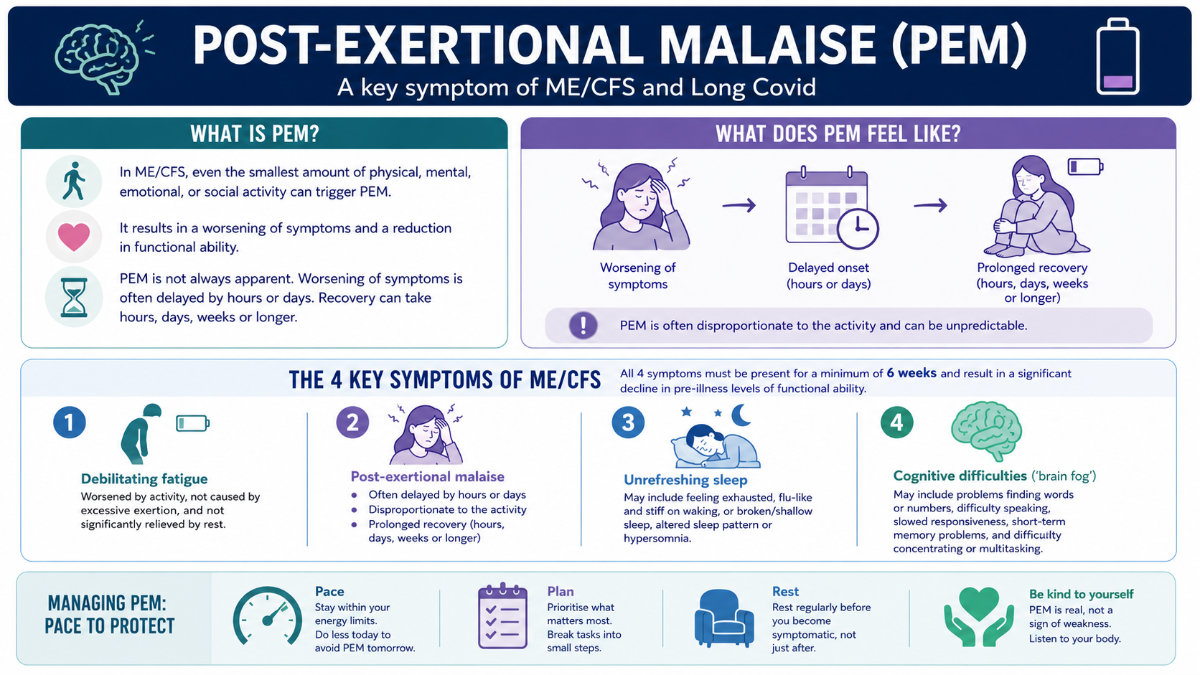
“The increase in fatigue is commonly delayed by 24 hours or more, so a typical pattern is for someone to try to do a bit more on a good day and then wake the next day feeling much worse.”
British Association for Clinicians in ME/CFS (BACME)
A clinical diagnosis can take time
There is currently no blood test, scan, or biomarker that definitively confirms ME/CFS. Diagnosis is reached by recognising the symptom pattern and ruling out other conditions that could explain them.
This means the process can feel slow and frustrating. The NICE guideline (2021) recommends that a provisional diagnosis is made at four months of symptoms in adults, and three months in children — but in practice many people wait far longer.
If you are awaiting a diagnosis and need support in the meantime, you do not need a formal diagnosis to contact us or to join the Society.
Recognise the symptom pattern
ME/CFS is characterised by post-exertional malaise, unrefreshing sleep, and cognitive impairment alongside significant fatigue lasting four months or more in adults.
GP assessment & blood tests
Your GP will carry out blood tests to check for other conditions — including thyroid problems, anaemia, and diabetes — that can cause similar symptoms.
Ruling out other causes
For some people, further investigations or specialist opinions are needed before other explanations can be excluded. This stage can take time.
Formal diagnosis
There is no single test for ME/CFS. Diagnosis is clinical, made by a doctor based on the symptom pattern and duration, once other conditions have been excluded.
Outlook & recovery
Prognosis is variable — but recovery is possible.

“Prognosis is variable and unpredictable. Quite a lot of people who become ill after infections can recover relatively soon, especially if diagnosed and managed early. But others may take longer to recover. Although most people do gradually improve, a significant minority remain severely affected for long periods.”

Professor Anthony J Pinching
Clinical Immunologist & ME/CFS Specialist
“Recovery from ME/CFS is extremely variable and will be affected by a number of factors. It is essential that those affected are aware that full recovery is possible whatever the severity of the condition. Early diagnosis and appropriate management significantly improve outcomes.”

Dr Alastair Miller
Consultant Physician, ME/CFS Specialist
“Successful treatment relies on an accurate diagnosis and a personalised approach that addresses the factors contributing to and sustaining CFS/ME. Recovery times vary greatly, although patients whose illness follows an acute infection may improve more quickly. An experienced, well-staffed team is essential.”

Dr Alan Stewart
Medical Practitioner, ME/CFS Specialist
Living well with ME/CFS
There is currently no cure for ME/CFS but with appropriate management, a significant number improve and some move on to lead reasonably active lives.
Pacing
Understanding and staying within your individual energy limits is the cornerstone of self-management for ME/CFS. Pacing helps break the push-crash cycle and gradually builds stability over time.
Healthcare
Working closely with your GP and, where available, an ME/CFS specialist clinic or occupational therapist. Clear, ongoing communication about how symptoms fluctuate is essential.
Community
Connection with others who genuinely understand reduces isolation and improves wellbeing. Our support groups, helpline and conferences offer practical help and peer understanding.